Thursday, 1 November 2012
The Birth of the Wellington Wine District
If someone mentioned wine from Wellington, how many of us would associate it with South Africa rather than New Zealand?
Wellington was a ward (sub region) of Paarl until last month. On 21st September 2012, it was officially demarcated as Wellington District, on the same level as Stellenbosch and Paarl. Being a district instead of a ward also means that, if it so chooses, it could one day subdivide the district into wards although it is too early for that at this stage.
Duimpie Bayly, Chairman of the Demarcation Committee of the Wine of Origin System in South Africa, was proud to announce the birth of this new region. He explained that the distinctive terroir of Wellington differentiates this little region from Paarl and justifies demarcating such a small area.
Wellington District has only just over 20 producers. Apart from the co-ops, most are small to medium size estates. The soil is mainly decomposed granite from Groenberg (Green Mountain) which is an extinct volcano. Vineyards in the foothills of the Hawequa mountains benefit from the various mesoclimates created by the folds and valleys of the mountains. Not only does the Hawequa acts as a rain barrier, it also channels the south-easterly winds (the Cape Doctor) down the valleys. Summer may be hot but there are cool pockets where vines are sheltered from the strong afternoon sun by the mountains. Some vineyards on the slopes can be 3ºC cooler than the valley floor. I agree that this terroir is definitely different from that of Paarl. In 2010, it was proclaimed ‘Top Wine Area’ at the South African Terroir Awards.
Wellington produces more than its fair share of award-winning Pinotages, a unique South African cross between Pinot Noir and Cinsault. The rich chocolate-coffee easy drinking style, exemplified by Diemersfontein, is particularly popular among young consumers, while the more complex Cape blend with at least 30% Pinotage, such as Doolhof Minotaur 2008, appeals to more experienced drinkers.
Wine consumers have a love-hate relationship with Pinotage. Dave Hughes from The Pinotage Association admits that producers in the early days did not know how to make it, and the result was a green and bitter metallic taste (some people called it rusty nails). But with more understanding and experiment, Dave maintains that Pinotages these days are in much better shape, and consumers should not judge them from past history. Whilst I agree, I also think it’s fair to say that Pinotage is an acquired taste. It has to go with the right kind of food, like robust-flavoured Shanghai or Peking cuisines, or, as South Africans prefer, the braai (barbecue). Pinotage’s fruitiness and smoky aromas complement the sweetness of the food.
If you are a Cabernet fan, I would strongly suggest you try the Mont du Toit Le Sommet 2003, a blend of Cabernet Sauvignon, Merlot and Syrah. At nearly 10 years old, the blackcurrant fruit is well integrated with the tertiary aromas of truffles and preserved eggs.
Wellington whites are fairly full bodied because of its hot summer. I like the barrel fermented Chenin Blancs, notably Nabygelegen and Diemersfontein Carpe Diem, which are food-friendly and structured without being overly heavy. Those who prefer lighter style whites will be pleasantly surprised with the refreshing Signatures of Doolhof Sauvignon Blanc at only 12.5% alcohol. The vines are planted on a slope and only exposed to the cool morning sun.
Wellington has long lived in the shadow of Paarl but with this elevation of status it can be more proactive in marketing. South African wine routes are world famous but most tourists stick with the more well known Stellenbosch and Franschhoek regions. I have to admit that Wellington town is not as vibrant as Stellenbosch and certainly lacks the sophisticated touristy atmosphere of Franschhoek. But these are compensated by its tranquil and relax feel. The surrounding scenery is just as spectacular as Stellenbosch. If you like nature, you will not be disappointed. The Wellington Wine Walk is a 40 kilometre 3-day guided walk in the winelands and surrounding fynbos (the native small bushes of South Africa) that incorporates luxury accommodation and wine tastings—not a bad ‘exercise programme’ for wine lovers. If you are very lucky, you may even be able to glimpse the endangered Cape leopard. By the way, Wellington is only one hour from Cape Town and 30 minutes from Stellenbosch so there’s no excuse not to drop by.
Wellington is also known as the cradle of vines. Not only do its 28 nurseries supply over 90% of all vine cuttings to South African producers, they also export to countries including China and Uruguay. At the celebration dinner for the official launch of the Wellington Wine District, each guest was given a young vine to signify the new beginning of Wellington, a very meaningful idea indeed.
The South African wine industry will always be dominated by Stellenbosch, its big brother (like Bordeaux to France), but I hope we wine lovers will give a chance to its little siblings. Wellington may be the latest one but I’m sure there will be more to come. South Africa prides itself as a fauna rich and biodiverse wine kingdom and only by having more demarcated regions can we truly experience the diverse wine styles offered by this Rainbow Nation.
Congratulations Wellington!
Abridged version was published in the South China Morning Post on 1st November 2012
Sunday, 14 October 2012
Red wine and oak
![]() |
| Chateau Margaux |
Friends tell me they prefer red wine with oak. I also hear people say that wine must spend time in oak or it won’t be good. But exactly what does oak taste like? Indeed does it have any taste at all? And is it really essential that red wine be aged in oak?
Oak is good for barrel storage because it’s strong yet can be bent without breaking and, when wet, expands to allow watertight joints. More importantly, it imparts flavours and allows small amounts of oxygen transmission so the wine can develop over time.
Sounds simple enough. Yet for the winemaker there are lots of variables to play with. Consider just five:
First, where does the oak come from? French oak has tighter grain and more wood tannins but more subtle aromas while the wider grain white American oak has less tannins and more pronounced aromas. Hungarian and Slovenian are also available.
Second, how has it been toasted? Toasting is an essential link between wood and wine. It destroys wood tannin molecules but makes available all kinds of aroma, from coconut and clove to dark chocolate and smoke, depending on the temperature and length of toasting. Wine aged in untoasted barrels has no complex aromas and its tannin is so raw that it is like biting into a piece of plywood. A ‘light toasted’ barrel gives herbs and spices, while medium toasting brings vanilla, cinnamon and smooth wood tannin. Wine aged in heavily toasted barrels acquires pronounced roasted coffee and caramelised flavours and less wood tannin.
Third, how ‘old’ is the barrel—that is how many times has it been used? New oak imparts the most aromas and wood tannins. Second and third filled barrels impart only about 50% and 30% as much, and those over five years old virtually none at all. But even the oldest barrel still allows that vital oxygen ingress, softening the wine over time.
Fourth, how big is the barrel? Small ones have a higher wood area to wine volume ratio so impart more flavour per litre than bigger ones in a given time. Small new barrels, such as the 225l barriques from Bordeaux, give the most intense aromas.
Fifth, how long should the wine be kept in barrel? Times range from a few months to a few years. Obviously the longer the time the greater the potential for imparting flavour and the effects of oxygen.
When you consider how many permutations of just these five variables are available to the winemaker you can see how much room he has for influencing the final wine.
Not all wines benefit from maturing in oak, let alone new oak. A concentrated and structured Cabernet Sauvignon may stand up to 100% new oak for 18 months, or even ‘200%‘ new oak by racking the wine from one new barrel to another. But this combination would overpower a more subtle wine like a Burgundian Pinot Noir, which might need only about 30% new oak to preserve its delicate structure and some winemakers would not use new oak at all. Similarly, Dolcetto might need no time at all in barrels in order to preserve its primary fruit aromas.
Unfortunately, some consumers have the perception that ’the more oak the better’, leading some producers to over-oak their wine, which may be pleasing at first but quickly gets tiring. I did a blind-tasting of nearly 100 2009 and 2010 St Emilion Grand Crus Classés with Thierry Desseauve, a leading French wine critic, and we both agreed that most were over-ambitious with the oak, but then that is what some consumers prefer.
There is a joke that if one wants wood, one should just bite into toothpicks—it’s cheaper than buying woody wine! Oak, like other components including acidity, alcohol, tannin and sugar, should be integrated and never stand out. The aromas of spices and vanilla should complement the wine by adding complexity, not kill the fruit. Perfectionist producers might choose to age their wine in a mix of American barrels, French barrels and stainless steel, and/or new and old oak in different proportions before finally blending to ensure the right amount of oak is imparted.
New barrel maturation is expensive and slow. For entry-level wine aimed at satisfying consumers’ desire for oak, the industry has come up with alternatives to barrel maturation using wood chips and staves. They can be French or American oak with different toasting levels exactly like barrels, but at a fraction of the price. Bags of oak chips, reminiscent of giant tea bags, can be placed in the tank during fermentation, so by the time fermentation is completed the wine has already acquired some wood aromas and the ‘wood ageing’ time can be much shorter.
Chips or staves are usually used in conjunction with micro-oxygenation, where measured amounts of oxygen are bubbled into the tank to soften the wine, mimicking the effect of barrel maturation. These techniques were considered inferior when first introduced, but most winemakers master them now and can make consistently reliable good-value wine.
Lesson to take home? Not all wines need or are suitable for oak ageing. A HK$100 wine ‘aged in new oak’ probably means chips not barrels, but that doesn’t mean it’s bad. As long as it is balanced and integrated, it’s a good wine. It is rather like fast food: the quality is there for the price you pay, but don’t expect it to taste and feel like Michelin starred cuisine. Jancis Robinson MW once said she has absolutely no problem with staves or chips as long as the wine is balanced and authentic.
Abridged version was published in the South China Morning Post on 16th August 2012
Monday, 24 September 2012
China wine from the Scottish castle
I was so happy to be able to get my winery hands dirty again, this time at Treaty Port in Yantai, China.

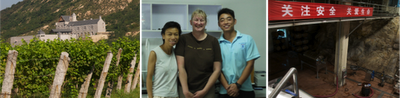
Most wineries in China need to make a statement, and this one does so in the somewhat startling form of a Scottish castle set on a hillside overlooking a reservoir about 30 minutes south of Penglai. I was picked up from the airport in a blue London cab and greeted at the castle by staff wearing Scottish kilts. All very posh, and I was not quite sure what to make of the whole thing until I met the owner Chris Ruffle and his Australian consultant winemaker Mark Davidson.
Chris is a Yorkshireman who has spent years in China making his fortune as a money manager. It is easy to assume that the Treaty Port project is a rich man's toy, but instead of boasting how great the wines are, Chris talked about the diseases in the vineyards and other challenges. 2009 was the first vintage and there was no 2010 because the crop was lost to frost. 2011's was small and this year was better although still not significant. Chris and Mark are in constant discussion about how to improve the vineyards: planting grass between rows to bind the soil, using organic matter to improve it, raising the trellising higher to minimise the threat of mildew, replacing varieties that are not suitable for the site. He is open to ideas and the goal is to produce a good quality wine that China can be proud of.
To make sure the winery is run to international standards Chris employed Shao, a young local man with no previous winemaking experience, to learn from Mark, even sending him to Hunter Valley to work in Mark’s winery for a few months. Shao, sensing the opportunity, is hardworking and willing to learn. Instead of just doing whatever he is told, he thinks and tries to understand the 'why'. Eager to pass on some of my own winemaking knowledge, I saved wine and juice samples from before and after trials for him to taste, so he could see the reasons why we stopped fermentation of the Riesling at a particular point, or added bentonite to this tank, or blended the two rosés together. He told me he would like to develop a career in winemaking. He is in the right place at the right time. I wish him all the best. China's wine industry is going to need a lot more enthusiastic youngsters like him.
Yantai may not be the perfect location for vinegrowing, the Scottish castle may be too imposing for some, and Treaty Port wine may still need a few years to establish its identity, but having lived and worked here with the staff, albeit only for a couple of weeks, I do believe there is a future for Yantai and Treaty Port. Old World wine regions have had hundreds of years of experience to match the vine varieties with the terroir. Yantai is still at the experimental stage; they will get there one day. The important thing is the willingness to learn and improve, and—I can’t emphasise enough—the passion. A wine is always more enjoyable when you know the story behind it, and Treaty Port certainly has its story. Sure, there is lots to be improved, and the weather is not ideal but it is the enthusiasm of the Yorkshireman with his equally eager Chinese team who believe China can produce good wine that will make the difference.
If you have a chance, spend a relaxing weekend at this Scottish castle. You’ll be pampered by Emma, the manager of the castle and her brilliant cooks—local ladies who were sent to Shanghai to learn western style cooking. Enjoy the countryside, full of apple and peach orchards. And if you are lucky, perhaps you may bump into Mr Rothschild at the Lafite vineyard around the corner from Treaty Port.
Monday, 27 August 2012
Paul Symington, the family man
It was absolutely fascinating to have the opportunity recently to talk to Paul Symington, the chairman of Symington Family Estates in the Douro, Portugal. We discussed everything from the future of port and climate change to history and the Queen’s jubilee celebrations.
What struck me was Paul’s emphasis on family values. Symington has over 350 years of history in Portugal and Paul is the 13th generation. He runs the company together with his two cousins Johnny and Rupert. When he was informed that he had been voted Decanter's Man of the Year 2012, he told Decanter he would only accept the award if he could mention and extend the honour to the family. He may be the face of the company, but it is the joint effort of all family members that makes Symington what it is today.
Paul firmly believes in the synergy between wine and family. Wine is long term and fits well with the time horizons of a family, especially for port and other premium wines that can evolve for half a century. He is proud to be selling today wine that his father put in barrels some 20 years ago. Big corporations, notably the public ones, often focus on the short term with today’s profit outweighing long term investment and heritage. To preserve and promote the moral values that are the backbone of family businesses, Symington joined with eleven other top international family estates to establish Primum Familiae Vini (PFV), the First Families of Wine, in 1993. PFV membership is by invitation only and is limited to a maximum of 12 families.
Being a family estate with long traditions does not mean lack of vision. Paul knows that the future of port lies with the premium sector—tawnies and vintages where Symington has a 34% market share—and the new consumers in the UK, US and Asia, and that the traditional image of cigars, port, gentlemen's clubs and copa (small port glasses) does not fit the lifestyle of today’s customers. To modernise port’s image, the three port houses under Symington—Dow’s, Graham’s and Warre’s—partnered with Croft, Fonseca and Taylor’s (The Fladgate Partnership) to establish the Vintage Port Academy. Its purpose is to promote the appreciation and knowledge of vintage port among fine wine consumers, collectors and wine professionals around the world. Some outside-the-box appeal includes pairing hairy crab and Peking duck, both Chinese delicacies, with tawny ports. To reinforce tradition and evolution, Symington launched Graham’s 1952 Tawny Port to celebrate the Queen’s 60th anniversary jubilee. The wine was served to overseas dignitaries at Windsor House. Paul’s ideal port scene is Brad Pitt and Angelina Jolie sitting in front of a big flat screen television in their posh Manhattan apartment, enjoying port from a Riedel wine glass!
The Douro is home for the Symingtons. Paul grew up there in the vineyards with his brothers and cousins, and joining the family business was a natural thing for him. Today, Symington is the biggest landowner in the Douro with over 974ha under vines. Each family member also has his own private vineyard. Sales of Port may be declining but the Symington family believes in the Douro’s terroir. Rather than investing overseas like other families such as Mouton or Mondavi, Symington only focuses on the Douro, expanding its portfolio into Douro AOC still wines. In 2010 it bought Cockburn’s Port from US company Beam Global Spirits & Wine in order to rebuild this 200 year old brand. Climate change, however, is a challenge as the average temperature has increased1.3ºC in the last 50 years. New planted vineyards are at higher altitudes and mostly north-facing. Luckily Touriga Nacional, the flagship grape of the Douro, is heat resistant and its sugar level does not increase as fast as in other varieties in the soaring temperatures.
Of course there are cases of family disputes leading to the collapse of great family empires such as Gucci. Paul understands the importance of keeping the family unified. All Symingtons start by doing basic work on the estates, then gain experience outside the Douro before joining the company. He is not worried about not having enough successors. There are enough daughters and sons—14—in the next generation, but it is up to them whether they want to join the family business. If you have a chance to visit the estates, keep an eye out for the young lads cleaning the table or serving you port, they may well be the next Symington Chairman, or the next Decanter Man/Woman of the Year.
Abridged version was published in the South China Morning Post on 26th July 2012
Labels:
Fladgate,
port,
Portugal,
Symington,
Vintage Port Academy
Subscribe to:
Posts (Atom)